
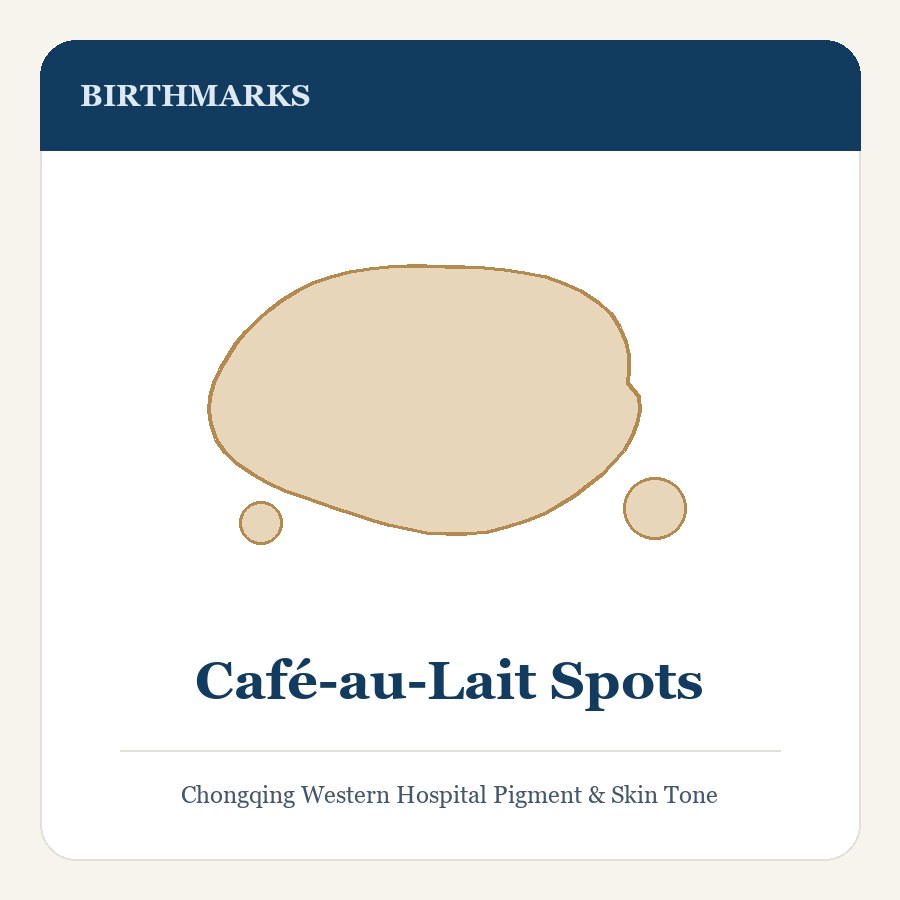
In short. Café-au-lait spots are flat, uniform light brown birthmarks present from early childhood. One to three spots in an otherwise healthy child are a normal variation; several spots above a certain size, especially with skin-fold freckling, warrant a paediatric or dermatology review. Most need no treatment.
Key points
- Isolated spots (one to three) are a normal variation needing no investigation or treatment.
- Number and size, not colour alone, decide when review is worth arranging.
- Six or more spots above the size threshold are a working rule for review.
- Neurofibromatosis type 1 is the best-known association; armpit or groin freckling is a clue.
- Laser lightening is variable, often incomplete, and can leave uneven pigment.
What does a café-au-lait spot look like?
A café-au-lait spot is a flat, uniformly light brown patch with a well-defined, slightly irregular border, roughly the colour of coffee with milk. Most appear in the first years of life, and they grow in proportion with the child rather than spreading. They can occur anywhere on the body.
How the cells produce a uniform colour
Under the microscope the melanocytes are not greatly increased in number, but they are larger and carry unusually big melanin packages. That is why the colour is uniform and the border is crisp; these are the features a dermatologist uses to tell these spots apart from other brown birthmarks.
When is a spot just a normal variation?
Isolated café-au-lait spots are common. One, two, or three spots in an otherwise healthy child are a normal variation and need no investigation and no treatment. They are not a sign of anything wrong, they do not turn into cancer, and they do not need to be removed.
When do several spots need assessment?
The picture changes with number. When a child has several spots above a certain size, and especially when other findings are present, the spots can be one feature of a genetic condition in which pigment cells and other tissues develop atypically. The best known is neurofibromatosis type 1, in which café-au-lait spots are joined by freckling in skin folds such as the armpit or groin, and by other features that appear over time. Other, rarer conditions can produce a similar picture.
| Finding | Isolated spots | Spots worth review |
|---|---|---|
| Number | One to three | Six or more (working rule) |
| Size | Small and in proportion with the child | Larger than about 5 mm in a young child, or 15 mm in an older child |
| Skin folds | No freckling | Freckling in the armpit or groin |
| Other findings | None | Family history, lumps, bone pain, developmental concerns |
| Usual meaning | A normal variation | One possible feature of a genetic condition such as neurofibromatosis type 1 |
| What to do | No investigation or treatment | Paediatric or dermatology review |
As a working rule, six or more café-au-lait spots larger than about five millimetres across in a young child, or larger than about fifteen millimetres in an older child, are worth a paediatric or dermatology review, particularly if there is freckling in the armpit or groin, a family history, or any other medical concern. The purpose is not to alarm; it is to look for the other features early, because some of them are easier to manage when they are known about.
Can they be treated?
Cosmetically, yes. Light and laser devices can lighten café-au-lait spots, usually over several sessions. The response is variable and often incomplete, recurrence is common, and there is a real risk of the patch darkening or losing pigment unevenly afterwards. Many dermatologists therefore advise caution, particularly in children, and many families reasonably decide to leave them alone.
When should a spot be checked rather than lasered?
When a spot is being considered for treatment, the first step is confirming what it is. A café-au-lait spot has a characteristic uniform colour; a lesion that is mottled, raised, or changing is not behaving like one and should be examined rather than lasered.
- A child has six or more such spots, or spots that are unusually large, or freckling in the armpit or groin.
- A spot is mottled, raised, changing, or accompanied by lumps, bone pain, or developmental concerns.
- New spots keep appearing in adolescence or adulthood; adult-onset lesions usually have another explanation.
Sources
- American Academy of Dermatology — café-au-lait spots and birthmarks
- British Association of Dermatologists — birthmarks in children patient information
- NICE — neurofibromatosis type 1 guidance
Internal links
Frequently asked questions
How many cafe-au-lait spots are normal?
One, two or three spots in an otherwise healthy child are a normal variation and need no investigation and no treatment. The picture changes with number, which is why six or more spots above a certain size prompt a paediatric or dermatology review.
When do cafe-au-lait spots need further assessment?
As a working rule, six or more spots larger than about five millimetres in a young child, or about fifteen millimetres in an older child, are worth review, particularly with freckling in the armpit or groin, a family history, or any other medical concern.
Can cafe-au-lait spots be removed?
Cosmetically, light and laser devices can lighten them over several sessions, but the response is variable and often incomplete, recurrence is common, and the patch can darken or lose pigment unevenly. Many dermatologists therefore advise caution, particularly in children.
Risks & Limitations
- Most chronic skin disease is managed rather than cured, and relapse is expected.
- Treatments typically need 8–12 weeks before response can be judged fairly.
- Topical treatment can cause irritation, dryness, peeling and photosensitivity.
- Systemic therapy may require blood monitoring and carries organ, metabolic and pregnancy risks.
- Isotretinoin in particular requires strict monitoring and pregnancy prevention.
- Pigment change is often slow and may be incomplete.
- No treatment works for everyone, and response cannot be predicted with certainty.
When to Seek Care
- A mole or lesion that changes in size, shape or colour, or starts to bleed, itch or crust.
- Fever with a widespread rash, blistering, or rash involving the eyes, mouth or genitals — seek emergency care.
- Rapidly spreading redness, swelling or pain in the skin.
- Facial swelling or difficulty breathing — possible severe reaction; seek emergency care immediately.
- New or worsening symptoms while taking a monitored medication.
References & Further Reading
- American Academy of Dermatology (AAD) — public and clinical guidance
- World Health Organization (WHO) — skin and infectious disease resources
- Chinese Medical Association, Dermatology Branch — clinical guidance
- Cochrane Library — systematic reviews in dermatology
This page is patient education, not medical advice, and it does not cite individual studies. Discuss your own case with a qualified clinician. To arrange an assessment at Chongqing West District Hospital, see Contact & Consultation.