
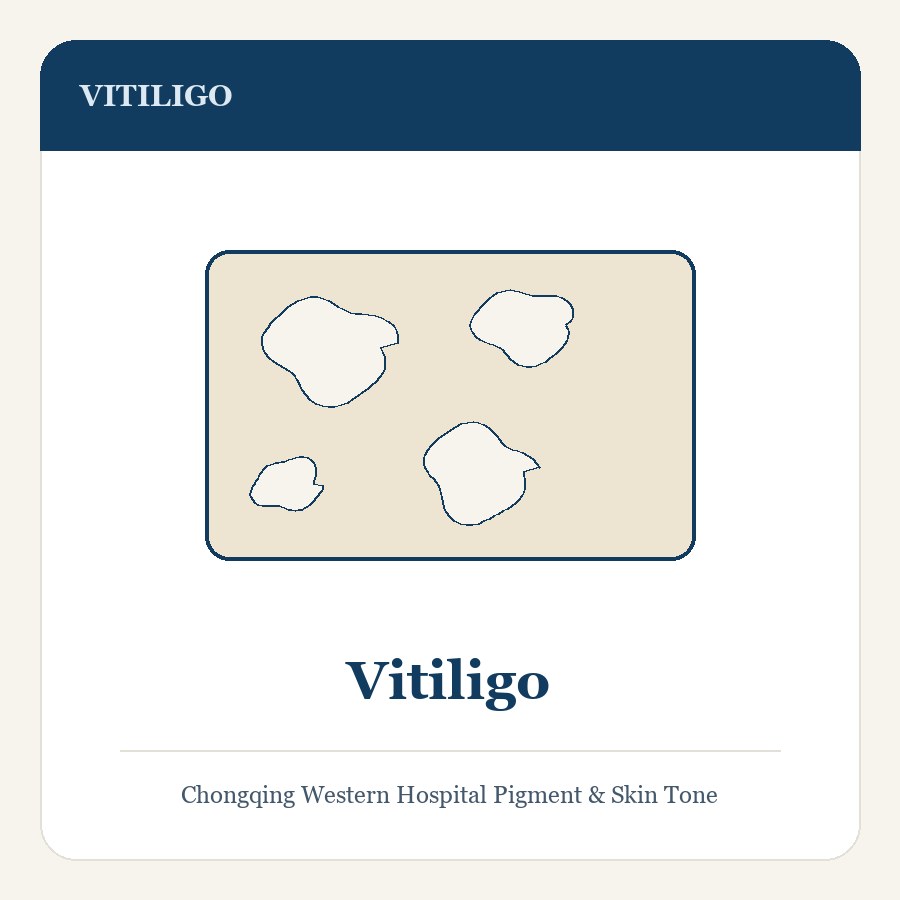
In short. Vitiligo is an acquired autoimmune condition in which patches of skin lose pigment completely and turn chalk-white. It is not an infection and cannot be passed to anyone; the immune system has destroyed the melanocytes in those areas. It affects all skin colours and is more visible in darker skin. Treatment can produce meaningful repigmentation but cannot promise it.
Key points
- Vitiligo is autoimmune melanocyte loss, not an infection, and it is not contagious.
- Patches are chalk-white and sharply demarcated because pigment is absent, not reduced.
- Thyroid and other autoimmune conditions are checked because they commonly coexist.
- Treatment classes are topical anti-inflammatories, phototherapy, and surgery for stable disease.
- Repigmentation is slow and partial, and the face responds better than the hands and feet.
Vitiligo is not an infection
Vitiligo is an acquired condition in which patches of skin lose their pigment entirely, producing sharply demarcated, chalk-white areas. It is not an infection, it is not contagious, and it is not caused by anything the person did. It happens because the immune system attacks melanocytes, the cells that make pigment. Once those cells are gone from an area, the skin there has no pigment at all, which is why vitiligo looks different from the pale, partial patches of other conditions.
It affects people of every skin colour, and it is more visible, and often more distressing, in darker skin. It commonly begins around the eyes, mouth, fingers, wrists, feet, and body folds, and it often affects both sides in a roughly symmetrical way. A phenomenon called Koebnerisation means that injury to the skin, including scratching and sunburn, can trigger new patches in some people.
How vitiligo is assessed
Examination is usually enough. A dermatologist looks at the distribution, uses a Wood lamp to make the loss of pigment obvious, and checks for the partial pigment loss that precedes full depigmentation. Because vitiligo is autoimmune, it is associated with other autoimmune conditions, most commonly thyroid disease, and blood tests for thyroid function and related conditions are commonly arranged. A small sample may be taken if the diagnosis is unclear or another cause of pigment loss is possible.
Why is the prognosis unpredictable?
Vitiligo behaves differently in different people. Some have a few stable patches for years; others spread steadily; many have long quiet periods interrupted by activity. No treatment reliably guarantees that the condition will stop spreading, and no treatment can promise full repigmentation. What can honestly be said is that many people gain meaningful repigmentation with treatment, that the face responds better than the hands and feet, and that it takes months to years rather than weeks.
What treatment classes exist?
Treatment falls into several classes.
| Class | What it does | How it is delivered |
|---|---|---|
| Topical anti-inflammatory agents | Corticosteroids and calcineurin inhibitors that interrupt the immune attack on melanocytes | Applied at home, prescribed and monitored |
| Narrowband ultraviolet B | Phototherapy for more widespread involvement | Clinic sessions, sometimes at home |
| Targeted light devices | Light treatment aimed at smaller areas | Clinic |
| Surgical grafting | Pigment cells grafted into patches that have stopped moving | Procedure |
| Depigmentation | Removes the remaining pigment so the colour is uniform | Procedure, for very extensive disease |
| Camouflage and self-tanning | Cosmetic colour matching | Self-applied |
Topical anti-inflammatory agents, including corticosteroids and calcineurin inhibitors, are used to interrupt the immune attack on melanocytes. Phototherapy with narrowband ultraviolet B, delivered in a clinic or sometimes at home, is the mainstay for more widespread involvement, and targeted light devices are used for smaller areas. Surgical techniques, in which pigment cells are grafted or transplanted into stable patches, are an option for disease that has stopped moving. For very extensive depigmentation, some people choose to remove the remaining pigment so that the colour is at least uniform, rather than trying to restore it.
Camouflage, sun protection and psychological support
Alongside medical treatment, camouflage and self-tanning products are legitimate and useful options, and depigmented skin needs protection because it burns readily with no melanin to shield it.
Vitiligo carries a psychological burden that is real and worth naming. The condition is not dangerous, but that does not make it easy, and treatment decisions reasonably include how much the appearance is affecting the person's life.
When should vitiligo be assessed?
- White patches are appearing or spreading, or the border becomes active and inflamed.
- You have other symptoms such as fatigue, weight change, or feeling unusually cold, which could point to a thyroid or autoimmune problem.
- You are considering a course of treatment; repigmentation is slow and needs a proper baseline and monitoring.
Sources
- British Association of Dermatologists — vitiligo patient information
- American Academy of Dermatology — vitiligo overview and treatment
- NICE — vitiligo clinical knowledge summary
Internal links
Frequently asked questions
Is vitiligo an infection?
No. Vitiligo is an acquired autoimmune condition in which the immune system attacks melanocytes, the cells that make pigment. It is not contagious and it is not caused by anything the person did. Once those cells are gone from an area, the skin there has no pigment at all.
What treatment classes exist for vitiligo?
Treatment falls into several classes. Topical anti-inflammatory agents interrupt the immune attack on melanocytes. Phototherapy with narrowband ultraviolet B is the mainstay for more widespread involvement, and surgical grafting of pigment cells is an option for disease that has stopped moving.
Will vitiligo repigment completely?
No treatment can promise full repigmentation, and none reliably guarantees that the condition will stop spreading. Many people gain meaningful repigmentation, the face responds better than the hands and feet, and it takes months to years rather than weeks.
Risks & Limitations
- Most chronic skin disease is managed rather than cured, and relapse is expected.
- Treatments typically need 8–12 weeks before response can be judged fairly.
- Topical treatment can cause irritation, dryness, peeling and photosensitivity.
- Systemic therapy may require blood monitoring and carries organ, metabolic and pregnancy risks.
- Isotretinoin in particular requires strict monitoring and pregnancy prevention.
- Pigment change is often slow and may be incomplete.
- No treatment works for everyone, and response cannot be predicted with certainty.
When to Seek Care
- A mole or lesion that changes in size, shape or colour, or starts to bleed, itch or crust.
- Fever with a widespread rash, blistering, or rash involving the eyes, mouth or genitals — seek emergency care.
- Rapidly spreading redness, swelling or pain in the skin.
- Facial swelling or difficulty breathing — possible severe reaction; seek emergency care immediately.
- New or worsening symptoms while taking a monitored medication.
References & Further Reading
- American Academy of Dermatology (AAD) — public and clinical guidance
- World Health Organization (WHO) — skin and infectious disease resources
- Chinese Medical Association, Dermatology Branch — clinical guidance
- Cochrane Library — systematic reviews in dermatology
This page is patient education, not medical advice, and it does not cite individual studies. Discuss your own case with a qualified clinician. To arrange an assessment at Chongqing West District Hospital, see Contact & Consultation.